

CES 2026 Event Recap
The year of agentic AI and physical AI

Check out our Substack chat thread for CES 2026 (link)
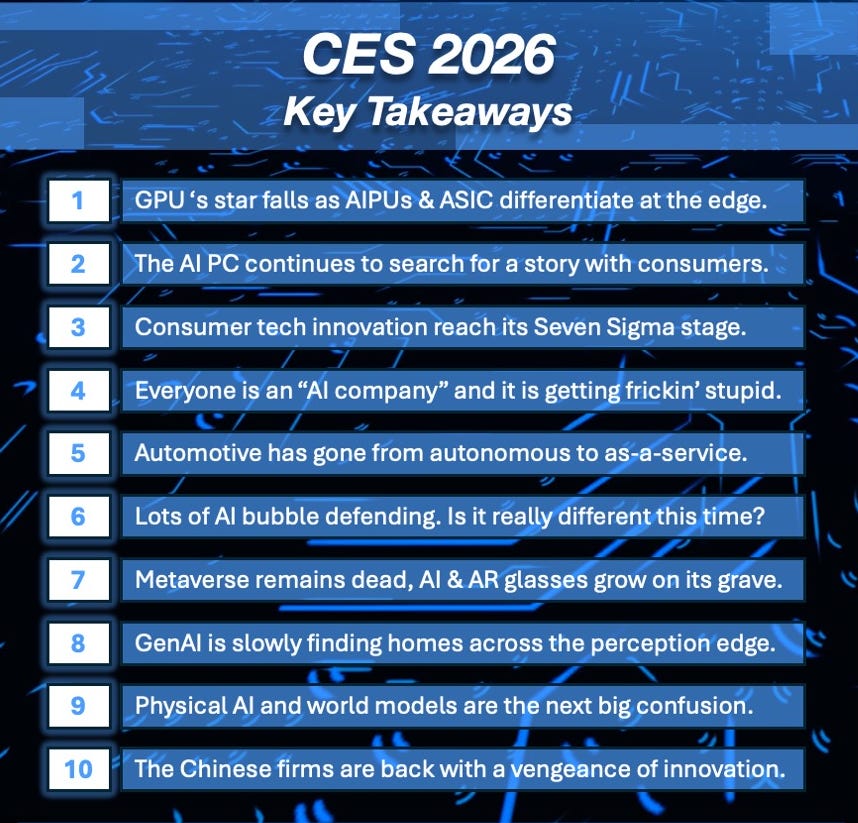
EVENT SUMMARY & HIGHLIGHTS
Another year, another CES. The event has pivoted so many times in the past few years as we have witnessed innumerable hypes that have cycled through the halls of the Las Vegas Convention Center.
In years past, we have seen the Internet of Things (IoT), the instrumented self, autonomous vehicles, smart speakers, industrial tech, metaverse, and now, AI supercomputing and infrastructure.
Yes, at a consumer electronics show.
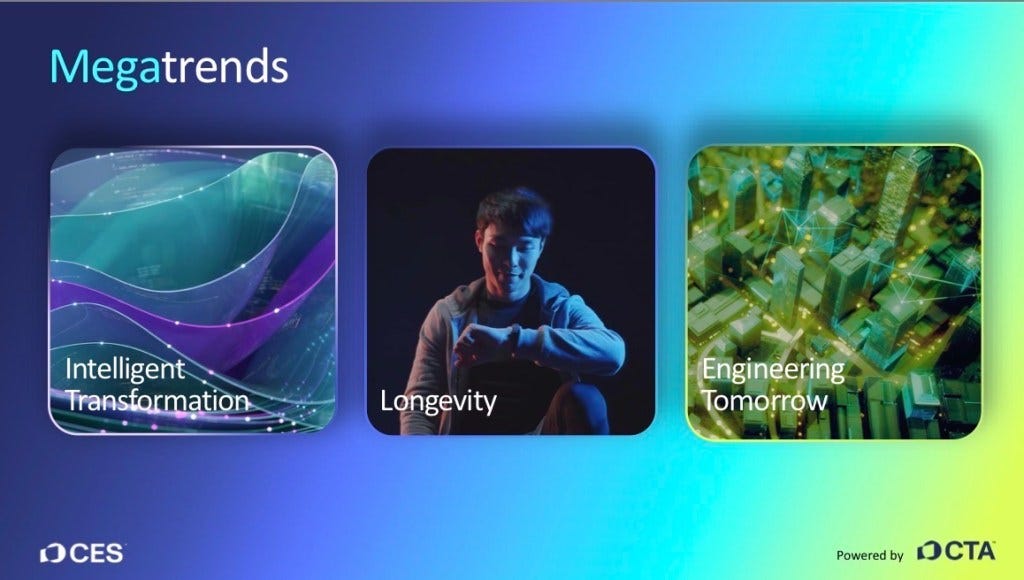
The CES 2026 Megatrends were about as nebulous as you could get. If you unpacked them, it was easy to see that they were containers for familiar tech themes of yesteryear. For example, longevity was about smart health and wellness and the instrumented self. Intelligent transformation referred to AI without saying AI.
Yes, we have seen AI before. So, what was new?
It was probably easier to notice what wasn’t there as prominently. For one, the West Hall is no longer the hub of automotive. It is now a mishmash of industrial tech attachments. You still see John Deere, Hyundai Heavy Industries, Caterpillar, and a diminishing spoonful of automotive brands.
Qualcomm and Waymo were the singularities of automotive fronting the next epoch of automotive, physical automotive AI, and mobility as a service except this time it is with cars instead of bikes and scooters.
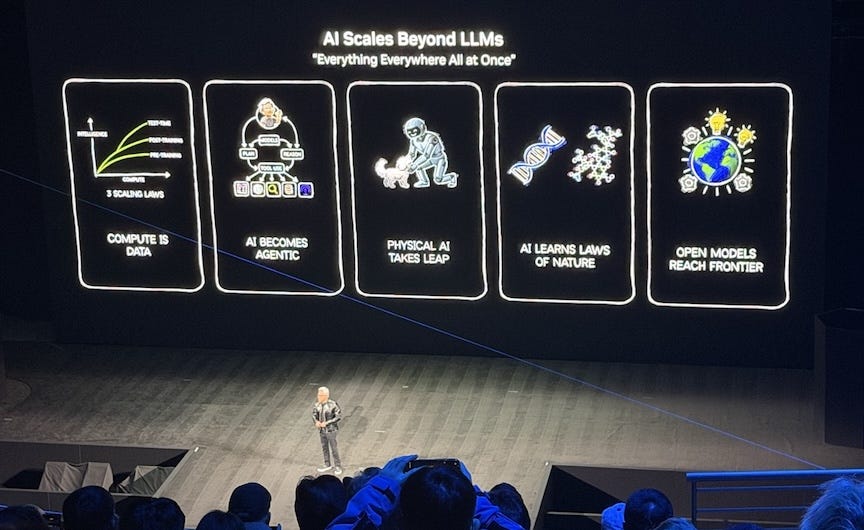
As we enter 2026, the question of whether all the AI infrastructure investments and the circular nature of the investment will pay off was on trial. NVIDIA made it a point to make a defense bringing in VCs and Wall Street analysts to a prologue panel to plead their case that there is no AI bubble before Jensen hit the stage for a keynote riddled with technical difficulties.
Yet the question of ROI lingers.
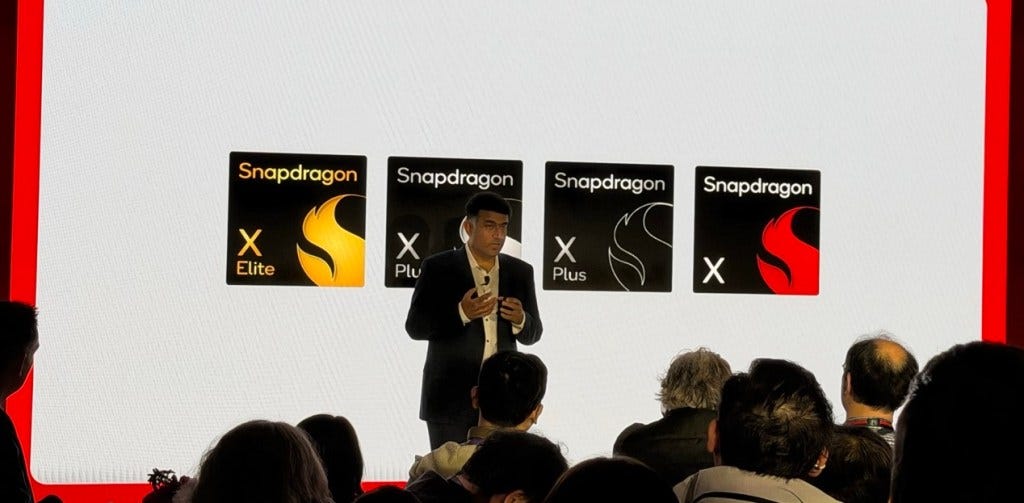
As the AI conversation pivots toward personal AI and physical AI, it was difficult to find a tech player that had a broader presence than Qualcomm. Their Snapdragon brand made statements in automotive, XR (in particular smart glasses), AI wearables, smartphones, audio, and the PC.
Qualcomm’s Dragonwing brand represented physical AI in robotics of the humanoid and industrial kinds with their IQ10 SoC. This is a testament to the company’s diversification strategy and an increasing gravity of edge AI.
Qualcomm wasn’t the only one planting roots in physical AI, which is a pretty nebulous concept at the moment. Is it just robotics? Is it more? World models? What is the net new? VLA (Vision Language Action) models?
I had a chance to hang out with the folks at Cadence and Ambarella, who gave me insight into how edge AI is likely to play out. Both companies walked me through their portfolios of DSPs and NPUs that are poised to become the resurgent classes of silicon that will host a fast-evolving and improving constellation of small AI models of all flavors that will populate the edge AI universe.
Every CES is a good one. This one was another great one to get a sense of the tech hype that will no longer be the hype next year or two, and the unexpected tech themes that will land in 2026 with purpose and meaning.
Highlights from CES 2026
The highlights and announcements from CES 2026 include:
Qualcomm Snapdragon X2 Plus – Qualcomm announced their next-generation Snapdragon X2 Plus AI PC SoC against rumors that Apple will be introducing an economy-tier Mac based on their A series mobile SoC that powers their iPhones. This comes at an important time for the PC industry as Qualcomm and its peers make the push to diffuse AI-ready PCs down from premium tiers they occupied for the better part of last year. (Snapdragon X2 Plus press release)
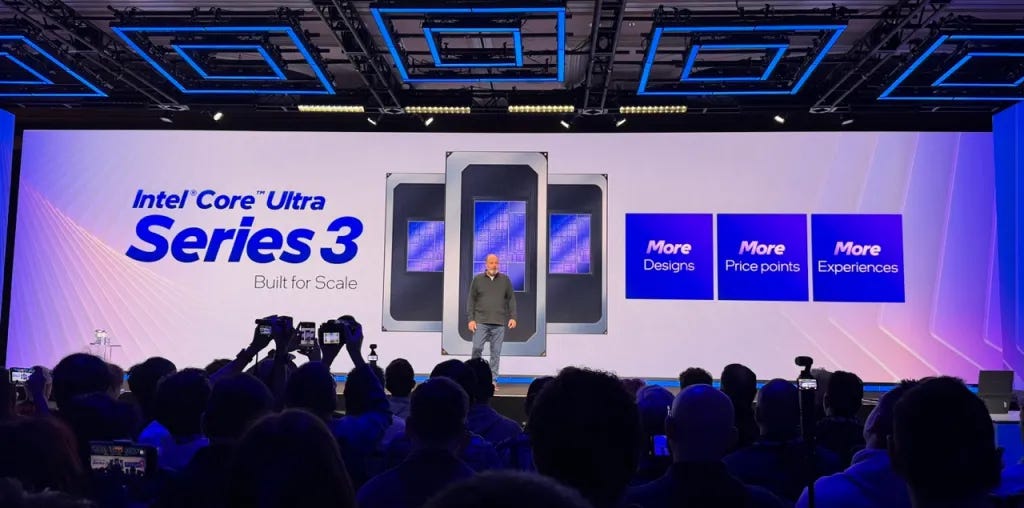
Intel Core Ultra Series 3 – 18A and Panther Lake have finally arrived. This was the pivotal moment for Intel on its long journey that has been the 5 Nodes in 4 Years (5N4Y) roadmap that Pat Gelsinger launched when he took the helm of Intel back in 2021. Just over four years later, it seems like Intel has delivered on backside power (PowerVia), a new Gate-All-Around transistor architecture (RibbonFET), and a very competitive part in Core Ultra Series 3. (Core Ultra Series 3 press release)
NVIDIA + Lenovo Liquid Cooling – Liquid cooling has become a hot topic in the world of AI supercomputing. The liquid cooling for NVIDIA’s Grace Blackwell rack systems have required purpose-designed data center cooling systems that depart from what we have seen in traditional data centers. NVIDIA’s announcement that Vera Rubin racks will use Lenovo’s warm-water cooling technology could bring these powerful rack into more traditional data centers, making them more conducive to enterprise deployments? They also reduce the need for chillers. An interesting prospect. (Lenovo Teams with NVIDIA on Gigawatt AI Factories Program press release)
The GPU-less AI edge – I met with the folks at Cadence and Ambarella to talk about their edge AI accelerators. Both companies are bringing vision models and multimodal AI to the edge running on DSPs and NPUs for low-power, low-latency edge applications for voice/audio AI and vision systems for automotive and security. (Tensilica HiFi DSP Family) (Ambarella CES 2026 product announcements)
Physical AI or RC? – Yes, humanoid robotics was quite the rage this year as NVIDIA continues to pump up the next phase in the long-running GenAI hype cycle. Why is this a highlight? It seems that most of the humanoid robotic demos that were presented as examples of physical AI were remote-controlled. They are not autonomous and only demonstrate how far we are from the lofty expectations being staged for humanoid robotics, and how remote control might be the case for 5G Advanced and 6G.
Wearables are back! – Smart glasses and AI pendants were the hot tickets this year, supplanting the AI PC, which has largely fallen flat. Most notably, Lenovo announced its entry into the pendant race with Motorola’s Project Maxwell, two years after the launch of the ill-fated Rabbit and Humane Pin. We are in a different place with AI compute. Both Meta and Lenovo are partnering with Qualcomm to bring the latest generation of multimodal AI models to these form factors. While the smart glasses seem to be gaining traction, especially in China, the jury is out on the pendant, which is largely in its experimental phase. (Motorola unveils ne flagship devices and AI-powered innovations)
neXt Curve MEDIA
CES 2026 Event Site (link)
LinkedIn: “neXt Curve at CES 2026” (link)
Substack: neXt Curve CES 2025 event chat (link)
LinkedIn: “CES 2026 Recap with Anurag Agrawal and Prakash Sangam” (link)
YouTube & Buzzsprout: “CES 2026 and Lenovo Tech World 2026 Recap” (video) (audio)
LinkedIn: “Day 1 of CES 2026” (link)
LinkedIn: “Day 2 of CES 2026” (link)
LinkedIn: “CES Unveil 2026 with Nitin Dahad of EE Times” (link)
LinkedIn: “CES Unveil 2026 with Sarbjeet Johal of Stackpane” (link)
LinkedIn: “CES Unveil 2026 with Wienke Giezeman of Things Industries” (link)
LinkedIn: “CT5 Inc. at CES Unveil 2026 and their glassless smart glasses” (link)
LinkedIn: “Qualcomm’s Snapdragon X Series Celebration with Fuad Abazovic” (link)
LinkedIn: “Jamming some Ratt at the Snapdragon X Series Celebration” (link)
LinkedIn: “The hunt for Motorola’s Razr Fold and booth tour!” (link)
LinkedIn: “IRL with Marcello Majonchi and Arduino at CES 2026” (link)
LinkedIn: “NVIDIA will be using Lenovo’s Neptune liquid cooling for Vera Rubin!” (link)
LinkedIn: “The hunt for Motorola’s Razr Fold and booth tour!” (link)
LinkedIn: “The new line-up of Motorola smartphones and devices at CES 2026” (link)
Substack: “Lip Bu Tan, CEO of Intel, talks 18A and Core Ultra Series 3 at CES 2026” (link)
COMPANIES ENGAGED
Lenovo, Qualcomm, Intel, AMD, Sony, Samsung, MIPS (Global Foundries), Cadence, Edge AI Foundation, Bosch, Amazon, Nordic, Semiconductor, Ambarella, Micron Technology, Arm, T-Mobile, Verizon for Business, Synapsys, Dell Technologies, Infineon, Hyundai Heavy Industries, Unitree, Blues, Afeela, Things Industries, Acetate, Loona, AIZip, KeyBike, Axatos, Zero, Panasonic
Follow us on LinkedIn, Substack, Twitter, and YouTube.
This material may not be copied, reproduced, or modified in whole or in part for any purpose except with express written permission or license from an authorized representative of neXt Curve. In addition to such written permission or license to copy, reproduce, or modify this document in whole or part, an acknowledgement of the authors of the document and all applicable portions of the copyright notice must be clearly referenced.
© 2026 neXt Curve. All Rights Reserved